
National Strategy and Infrastructure Framework
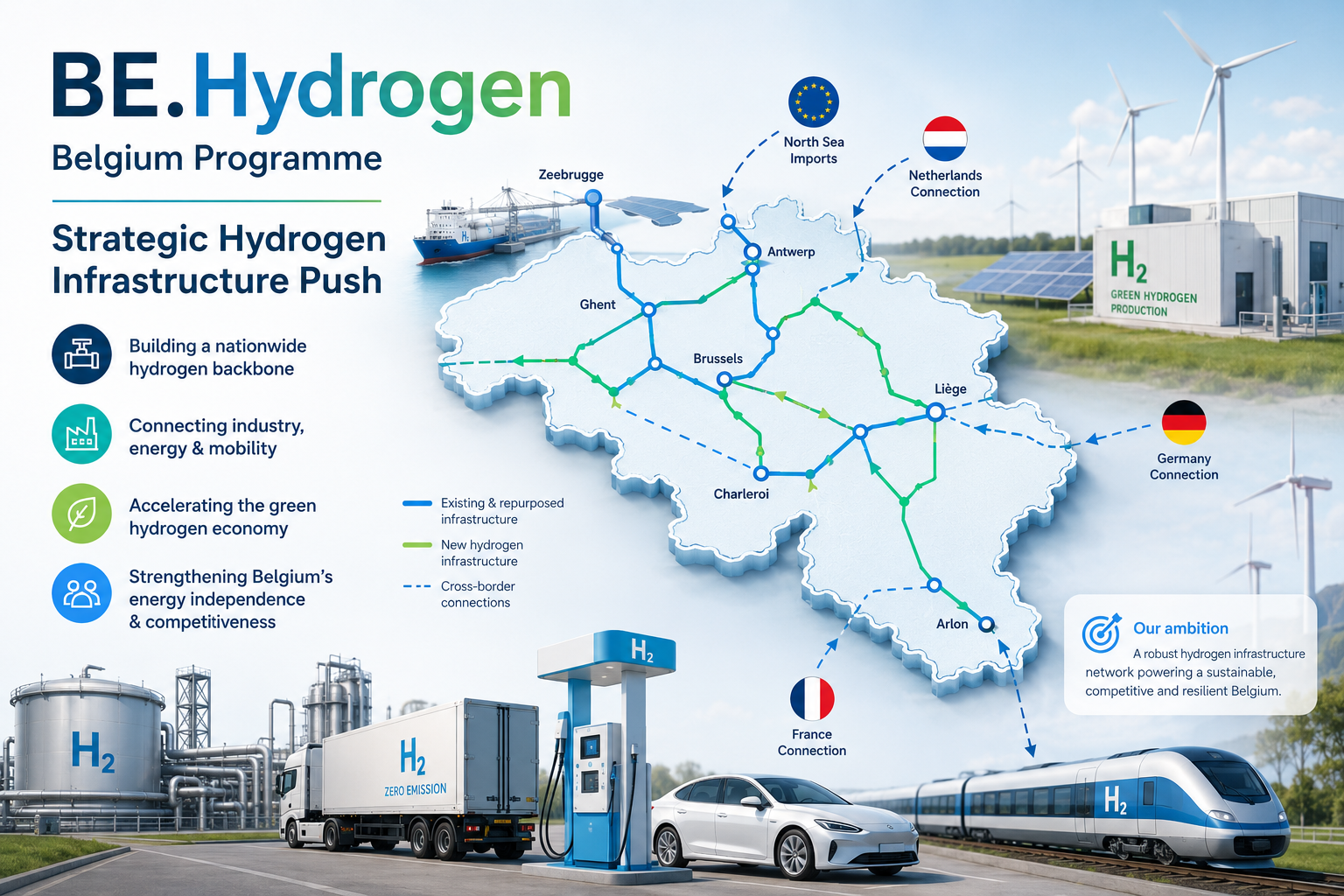
Belgium’s hydrogen strategy centres on coordinated public and private investment in production, transport, and industrial offtake infrastructure. The programme aligns with European Commission initiatives supported by the European Climate, Infrastructure and Environment Executive Agency (CINEA), which has highlighted Belgium’s accelerating hydrogen projects as part of the broader EU Green Deal and REPowerEU objectives. The country’s approach integrates renewable electricity generation—particularly offshore wind—with electrolyser deployment to produce green hydrogen at scale.
The programme’s institutional backbone includes partnerships between government agencies, utilities, and industrial players. PwC Belgium notes that the hydrogen opportunity spans production, storage, distribution, and conversion technologies, requiring cross-sector coordination. Belgium’s compact geography and existing gas network offer advantages for retrofitting infrastructure, while its major ports—Antwerp and Zeebrugge—serve as potential import and distribution hubs for both domestically produced and imported hydrogen carriers.
Key Projects and Industrial Partnerships
The 25 MW Hyoffwind green hydrogen production plant exemplifies Belgium’s industrial approach, with John Cockerill and BESIX confirmed as lead partners. The project integrates offshore wind power with advanced electrolysis technology to deliver industrial-grade hydrogen for chemical, refining, and heavy transport applications. This scale of deployment represents a critical first step toward multi-hundred-megawatt facilities envisaged under the European Hydrogen Backbone and national decarbonisation targets.
Belgium’s hydrogen ecosystem also explores natural hydrogen potential. Federal Climate Minister statements in March 2026 referenced the possibility of ‘white gold under our feet,’ signalling interest in geological hydrogen exploration alongside renewable production pathways. This dual approach—green hydrogen from electrolysis and potential natural hydrogen reserves—diversifies supply risk and could enhance Belgium’s competitive position in the European hydrogen market.
Policy Integration and Regional Coordination
Belgium’s participation in the Clean Hydrogen Partnership’s Hydrogen Valleys Days—scheduled for 4–8 May 2026 in Antwerp—underscores its commitment to cross-border hydrogen corridor development. The event brings together stakeholders from across Europe to discuss integrated hydrogen infrastructure, regulatory harmonisation, and project financing. Belgium’s strategy explicitly targets synergies with neighbouring markets, particularly through potential pipeline links to Germany, the Netherlands, and France.
The Green Hydrogen Organisation recognises Belgium’s national strategy as encompassing multiple pillars: production capacity, industrial conversion, transport infrastructure, and research and innovation. This comprehensive framework positions Belgium to capture value across the hydrogen value chain, from electrolyser manufacturing and hydrogen generation to specialised transport solutions and industrial decarbonisation services for hard-to-abate sectors including steel, chemicals, and heavy-duty logistics.
Sources
- Hydrogen – PwC Belgium
- Event announcement: Hydrogen Valleys Days – Clean Hydrogen Partnership
- Your EU – Your Projects in Belgium: accelerating hydrogen – CINEA
- Hyoffwind 25MW green hydrogen production plant – John Cockerill
Featured image via Unsplash.







Leave a Reply