

Mandates Create a Floor — and a Ceiling — for PtL Demand
ReFuelEU Aviation, now also formally adopted by Switzerland from 1 January 2026 for fuel suppliers at Zurich and Geneva airports, sets a clear regulatory escalator: a 2% SAF blend requirement today rising to 70% by 2050. That trajectory is the single most important demand signal for PtL project developers, because synthetic fuels are the only pathway capable of meeting the upper end of those targets at the volumes aviation requires. Against this backdrop, global SAF prices have climbed roughly 10% year-on-year to approximately $1,817 per tonne — around five times the cost of conventional jet fuel — underlining both the commercial opportunity and the affordability barrier that must be closed before PtL reaches mass adoption.
Hormuz shipping disruptions in mid-2026 have added an energy-security premium to feedstock logistics, squeezing margins for producers still dependent on imported hydrogen precursors or CO₂ sources. Developers with integrated, co-located electrolysis and direct-air-capture assets are better insulated from these shocks — a structural lesson the industry is absorbing in real time.
Where the Industry Stands: Projects, Players, and the Efficiency Reality
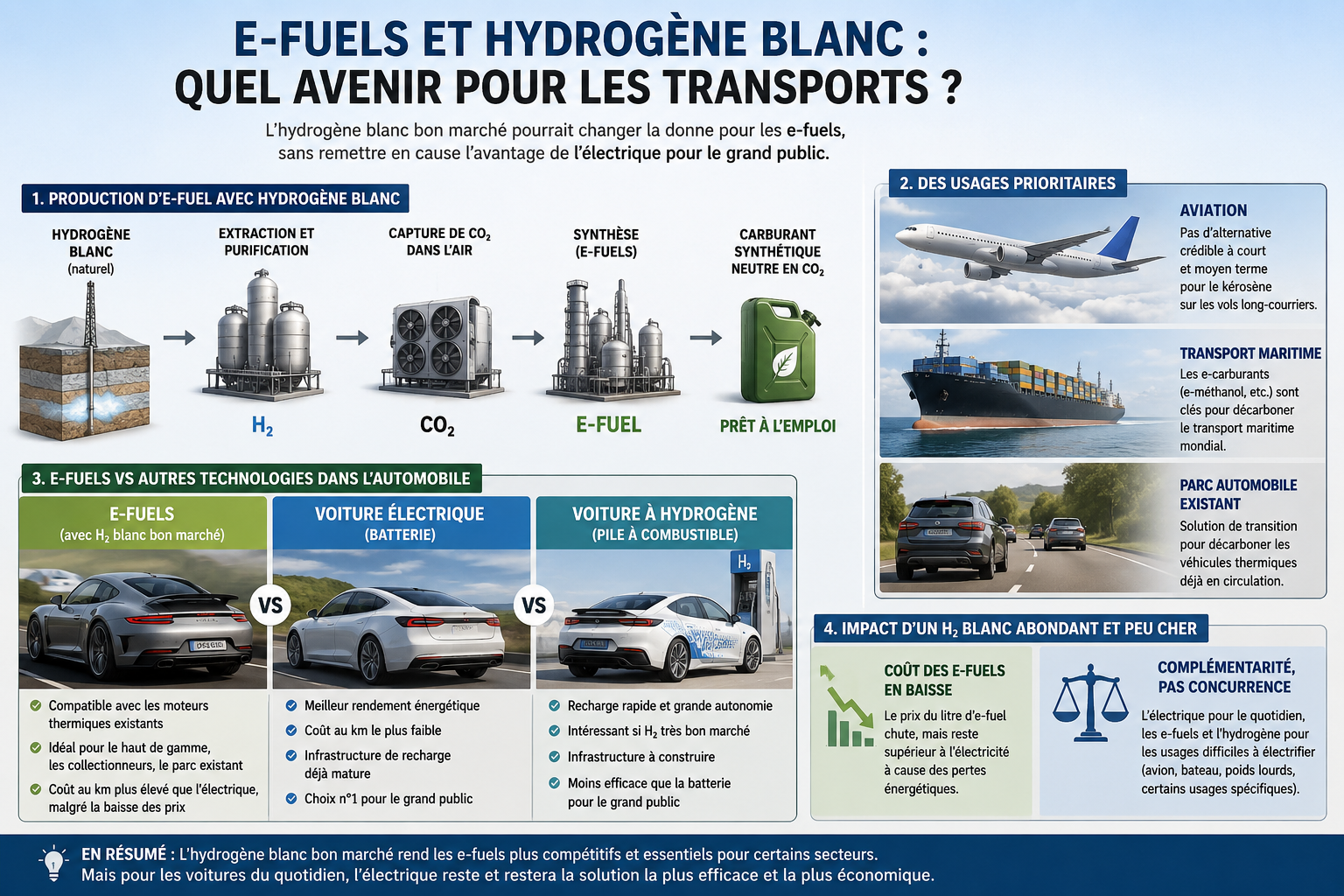
PtL remains a capital-intensive, electricity-intensive process. The well-to-wheel energy efficiency of an e-fuel powertrain sits at roughly 13–20%, compared with 70–80% for a battery-electric vehicle — meaning approximately five times more renewable electricity is consumed per kilometre in a combustion engine running on e-fuel. Transport & Environment, the ICCT, and multiple EU-level studies cite this gap as the central argument against deploying PtL in road cars and light vans, where batteries are a mature alternative. The honest answer from PtL proponents is that e-fuels are not competing with batteries for new passenger cars; they are serving sectors batteries cannot reach — long-haul aviation, deep-sea shipping, heavy long-distance trucking, high-temperature industrial processes, and the roughly 1.4 billion combustion-engine vehicles already on the road that will not be replaced overnight. Notably, the efficiency objection weakens if the hydrogen feedstock is produced not by electrolysis but by geological extraction of natural hydrogen, since no renewable electricity is consumed in its production — though that pathway is still at the exploration stage globally.
AI-driven demand modelling and scenario analysis are increasingly being applied across the synthetic-fuels ecosystem to stress-test project economics under different electricity-price, carbon-price, and mandate trajectories — helping developers and financiers identify which PtL configurations are robust across a wide range of futures rather than optimised for a single central case.
What Investors and Policymakers Should Watch
The near-term commercial battleground for PtL is aviation SAF, where mandates are legally binding and offtake contracts are bankable. Maritime e-methanol is a parallel growth corridor — COSCO SHIPPING’s completion of methanol dual-fuel retrofits on four large container ships, bringing its methanol fleet to seven vessels with more than 40 under construction, signals that ship operators are not waiting for perfect economics before committing. Advances in electrolyser durability — such as LG Chem’s interface-stabilisation technology that doubles PEM electrode lifespan and cuts iridium use by 50% — are gradually reducing the operating-cost component of green hydrogen, which feeds directly into PtL production economics.
The broader message for business decision-makers is this: PtL e-fuels are a complement to electrification, not a substitute for it. Companies building strategies around PtL should focus investment on applications where batteries genuinely cannot do the job, secure long-term offtake agreements anchored to mandate schedules, and integrate AI scenario tools to manage the substantial uncertainty that still surrounds electricity costs and carbon pricing over a 15-to-20-year project horizon.
Sources
- Power-to-Liquids Primer: Fuel From Thin Air | BloombergNEF
- E-Fuels (Power-to-Liquid) Market Size, Forecast, 2035
Featured image via Unsplash.








Leave a Reply