

What the D20 Actually Is — and Why It Matters
The D20 is a range-extender internal-combustion generator, not a primary drive unit. It sits inside a plug-in electric vehicle and fires up to recharge the battery when grid charge is exhausted — meaning the wheels are always driven electrically, but the energy source can be e-methanol synthesised from captured CO₂ and green hydrogen. Horse Powertrain’s claim of a 47% fuel-to-energy ratio is significant: conventional petrol engines in hybrid duty typically achieve 38–42%, so the methanol chemistry is buying real efficiency headroom.
The axial flux motor claim matters commercially. Axial flux designs are lighter and more power-dense than radial alternatives but have historically been expensive to manufacture at scale. If Horse has genuinely industrialised the format for a mass-market price point, it removes one of the persistent objections to range-extender architectures in cost-sensitive vehicle segments — precisely where the installed base of combustion vehicles is largest and hardest to retire.
The Efficiency Debate: Where Range Extenders Fit Honestly
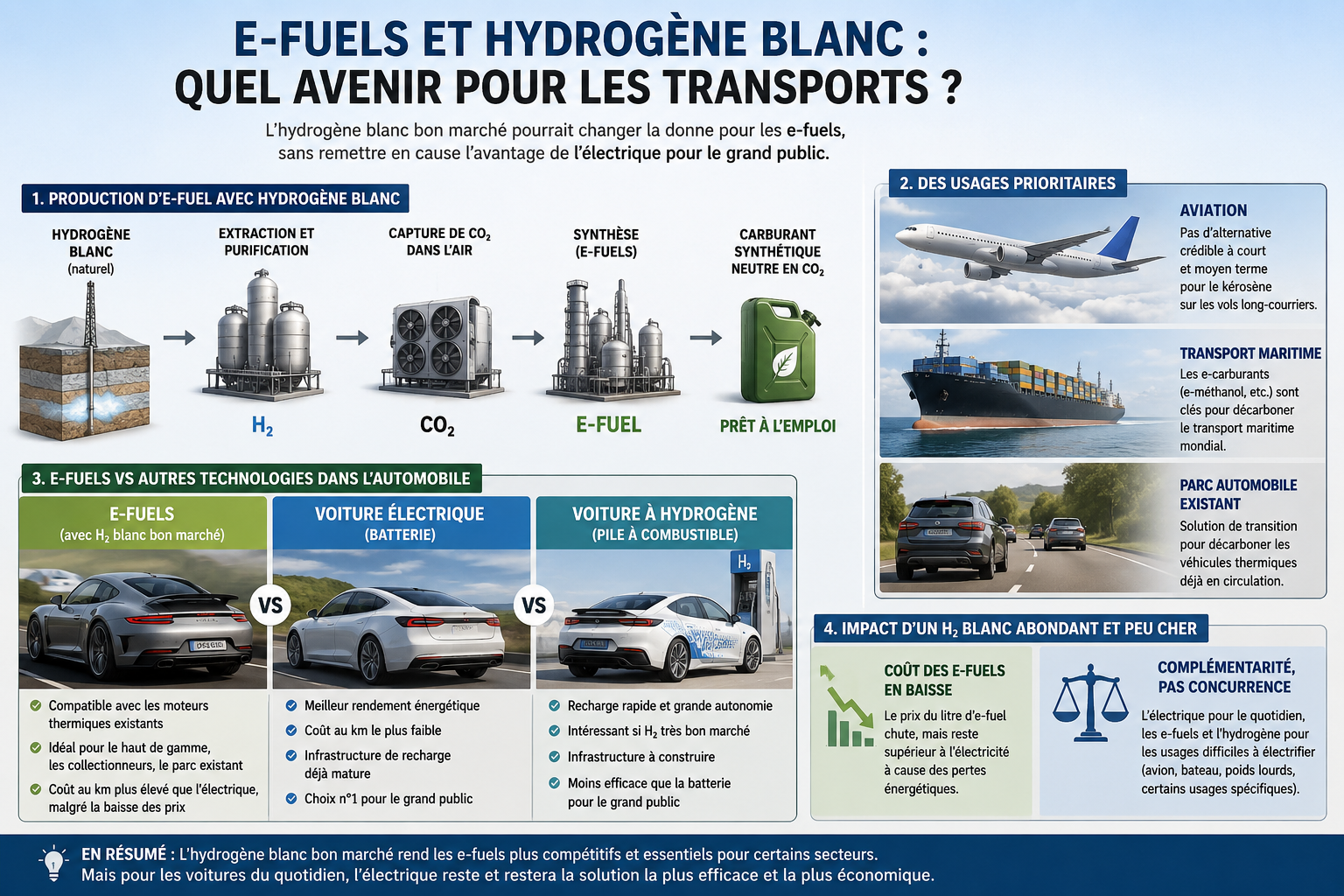
The central objection to e-fuels in road transport cannot be wished away: well-to-wheel, an e-fuel powertrain converts roughly 13–20% of input renewable electricity into motion, versus 70–80% for a battery-electric vehicle — approximately five times more electricity for the same kilometre. Transport & Environment, the ICCT and multiple EU-level studies make this the primary economic argument against e-petrol and e-diesel for cars. Horse Powertrain’s 47% figure is a fuel-to-energy ratio at the engine, not a well-to-wheel figure; the upstream electrolysis and synthesis losses still apply.
Where the D20 concept has a genuine answer is in the approximately 1.4 billion combustion-engined vehicles already on the road that will not be replaced overnight, in remote or off-grid markets where charging infrastructure does not exist, and in the growing class of light commercial vehicles whose duty cycles make pure-battery range inadequate. AI-driven demand modelling is increasingly used by OEMs and fuel producers to identify exactly these pockets — mapping grid availability, vehicle usage patterns and e-fuel supply chains simultaneously to target where range-extender deployments actually pencil out versus where a straight BEV is cheaper. The D20 is Horse Powertrain’s bid to be the hardware answer when the model says ‘range extender.’
Industry Context: Methanol as the Synthetic-Fuel Carrier of the Moment
The D20 does not exist in isolation. Methanol has emerged as the synthetic-fuel carrier attracting the most cross-sector momentum in 2026: COSCO SHIPPING has completed methanol dual-fuel retrofits on four large container ships and has more than 40 additional methanol vessels under construction, signalling that the fuel’s logistics infrastructure is scaling fast in maritime. A common fuel molecule across shipping and automotive range-extenders creates economies of scale in production, storage and distribution that neither sector could generate alone.
For investors and corporate strategists mapping the synthetic-fuels landscape, the D20 announcement shifts the conversation from ‘will there be demand for e-methanol in road transport?’ to ‘at what volume and in which vehicle classes?’ That is a more tractable question — and one the sector’s growing cohort of scenario analysts is well-placed to answer as production cost curves and regulatory frameworks, including the EU’s ReFuelEU mechanism and RED III, continue to evolve.
Sources
Featured image via Unsplash.










Leave a Reply