

Regulation Is the Real Accelerant
The European Commission moved in June 2026 to open infringement proceedings against 13 Member States that failed to communicate their ReFuelEU Aviation penalty regimes by the December 2024 deadline. The action is a signal that Brussels intends to enforce, not merely legislate. For e-fuel producers, that enforcement posture is the clearest demand signal yet: airlines that cannot secure compliant sustainable fuel face financial penalties, making offtake agreements with power-to-liquid plants commercially attractive in a way they were not three years ago.
Across the Channel, the UK Department for Transport published its planned approach to contract allocation under an upcoming SAF revenue support mechanism in July 2026, adding a second large market with structured demand. Together, these policy moves give project developers on both sides of the North Sea the regulatory certainty that underpins long-term debt financing — the missing ingredient for gigawatt-scale facilities.
Feedstock Infrastructure and the Green Hydrogen Link
Power-to-liquid fuels are only as green — and only as cheap — as the hydrogen that feeds them. LG Chem’s announcement on 27 July 2026 that it has doubled PEM electrode lifespan while cutting iridium consumption by 50 % is therefore directly relevant to e-fuel economics: iridium scarcity has long been cited as a ceiling on electrolyser deployment, and removing that constraint could meaningfully reduce the levelised cost of e-fuel production. Meanwhile, the HY4Link cross-border pipeline project, targeting completion by 2031 and spanning roughly 230 km to connect Belgian seaport import hubs through Luxembourg to French Grand Est industrial centres, is building the physical backbone that large e-fuel refineries will require. The project’s operators have also integrated digital-twin and AI monitoring tools to optimise pipeline performance and model demand scenarios — a quiet but significant adoption of AI-driven analysis that investors and grid planners are increasingly treating as standard practice across the synthetic-fuels value chain.
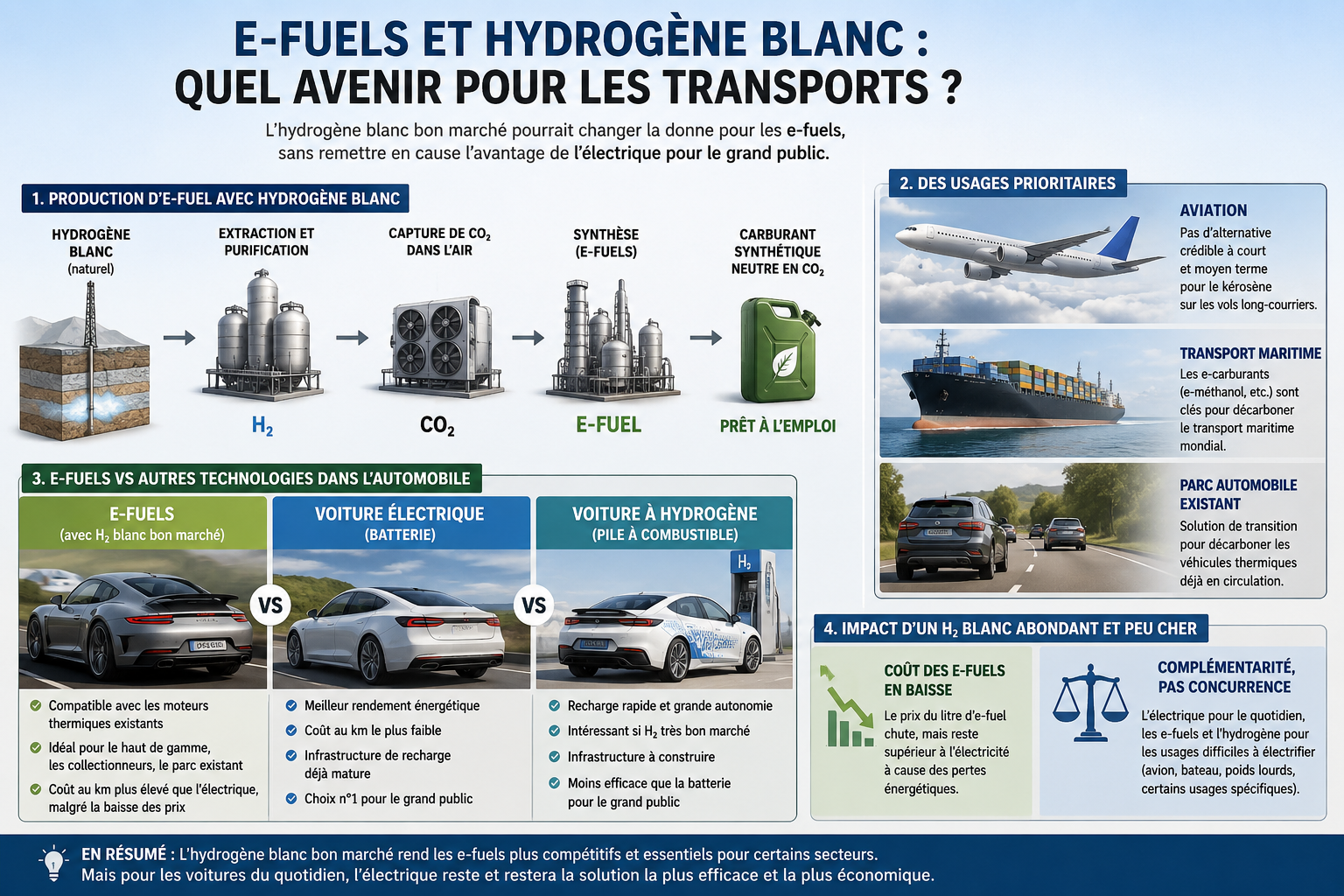
It is worth stating the central objection plainly: a power-to-liquid fuel powertrain converts roughly 13–20 % of input electricity into motion, compared with 70–80 % for a battery-electric vehicle — approximately five times more renewable electricity for the same distance travelled. Transport & Environment, the ICCT, and multiple EU-level studies have made this the primary argument against e-fuels in road transport. The honest answer is that the objection has real force for cars and light vans, but loses much of it for long-haul aviation, deep-sea shipping, heavy-duty freight, high-temperature industrial processes, and the roughly 1.4 billion combustion-engine vehicles already operating worldwide that cannot be retrofitted with batteries overnight.
What It Means for the Broader Ecosystem
The synthetic-fuels sector is coalescing around a clear division of labour: batteries and direct electrification for short-range road transport; e-fuels, e-methanol, and SAF for the hard-to-abate sectors where energy density, existing infrastructure, or operational range makes electrification impractical. Horse Powertrain’s Euro 7-compliant D20 methanol range-extender, revealed on 14 July 2026 with a 47 % fuel-to-energy ratio, illustrates how synthetic and biogenic liquid fuels are also finding a role as bridge technology in hybrid vehicles — extending electric range without requiring full grid-charging infrastructure.
For business decision-makers, the investment logic is sharpening. Regulatory risk is declining as enforcement actions clarify the cost of non-compliance. Feedstock costs are falling as electrolyser technology improves. And infrastructure is being built. The remaining variable is production scale: the industry must demonstrate that power-to-liquid facilities can be constructed and operated at costs competitive with fossil alternatives, a challenge that AI-assisted demand modelling and project-optimisation tools are helping developers address with greater precision than was possible even two years ago.
Sources
- HY4Link: integrated cross-border hydrogen infrastructure project
- Power-to-Liquids Primer: Fuel From Thin Air | BloombergNEF
Featured image via Unsplash.










Leave a Reply