
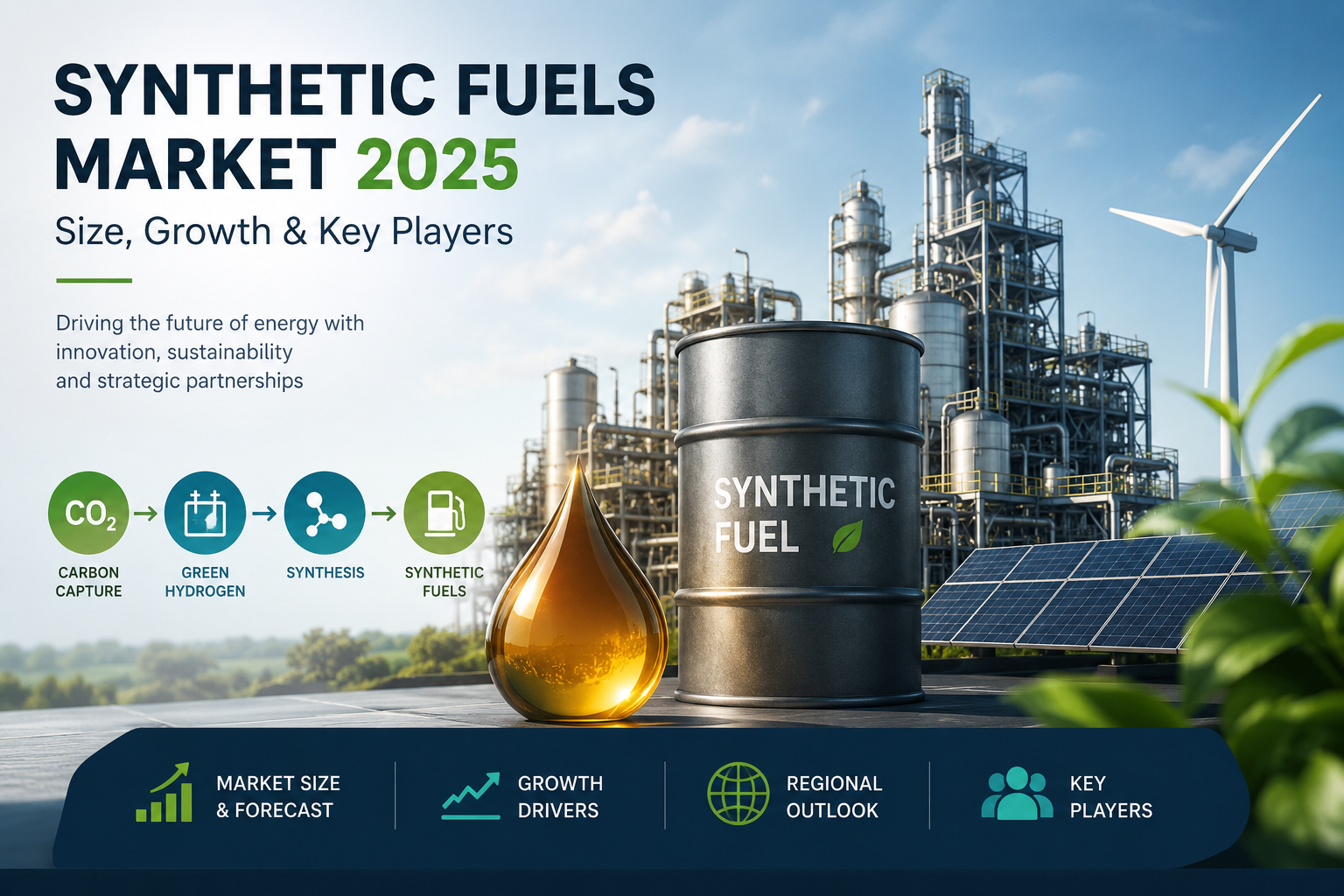

Synthetic fuels — also called e-fuels, power-to-liquid (PtL) or electrofuels — are produced from renewable electricity, green hydrogen and captured CO₂. They are drop-in replacements for fossil fuels, fully compatible with existing engines, aircraft and ships. With strong regulatory mandates, falling production costs and surging demand from hard-to-electrify sectors, the market is set for explosive growth through 2035.
What Are Synthetic Fuels?
Synthetic fuels are hydrocarbon fuels synthesised from non-fossil sources — primarily renewable electricity, green hydrogen and CO₂ captured from the atmosphere or industrial emissions. The result is a fuel chemically identical to conventional gasoline, diesel or jet fuel, but with a dramatically lower carbon footprint.
The key advantage: drop-in compatibility. Unlike hydrogen or electric vehicles, synthetic fuels work in existing engines, planes and ships without any modification. This makes them uniquely valuable for sectors where electrification is impossible — aviation, deep-sea shipping, heavy industry and the 200+ million legacy ICE vehicles on European roads.

Global Market Size & Forecasts
Market size estimates vary depending on scope, but all research firms agree on the trajectory: strong double-digit CAGR driven by regulatory mandates, falling production costs and surging aviation/maritime demand.
| Source | 2025 | Forecast | CAGR |
|---|---|---|---|
| Precedence Research (Nov. 2025) | $7.7B | $47.3B by 2034 | 22.4% |
| Fortune Business Insights (2025) | $11.7B | $154.9B by 2034 | 33.1% |
| MarketsandMarkets (2025) | $24.5B | $66.3B by 2030 | 22.0% |
| Grand View Research | — | $25.9B by 2033 | 16.3% |
| ResearchAndMarkets (SAF only) | — | $25.6B by 2030 | 65.5% |
Note: Variance reflects different scope definitions — narrow PtL e-fuels vs broad synthetic fuels including legacy coal-to-liquid and gas-to-liquid technologies. All figures from independent market research firms — not investment advice.
4 Main Production Technologies


Renewable electricity → electrolysis → green H₂ → synthesis with captured CO₂ → e-diesel, e-kerosene, e-methanol. Carbon-neutral if powered by renewables. Shell Hamburg PtL plant: Europe’s first commercial facility (Feb. 2025). Cost: $5–15/L, rapidly falling.
Processes waste oils, animal fats and used cooking oil into renewable diesel and SAF. Dominant technology: ~70% of SAF market share in 2025. Neste Rotterdam: 1.5 Mt/yr SAF capacity — world’s largest facility.
Converts syngas (CO+H₂) into liquid hydrocarbons via catalytic reaction. Produces drop-in fuels for aviation, road and marine. Second-largest SAF pathway (18% share). Synhelion DAWN plant (Germany): world’s first industrial solar fuel facility.
Converts bio-ethanol or synthetic methanol into jet fuel. LanzaJet Freedom Pines (Georgia, USA): world’s first commercial AtJ plant (2023). Boeing, Shell and MUFG are strategic investors. Honeywell hydrocracking: 90% CO₂ reduction vs fossil SAF.
Regulatory Framework — The Policy Engine
Regulation is the single biggest driver of synthetic fuel adoption. Without mandates, high production costs prevent market penetration. With mandates, the market has a guaranteed floor demand.
Key Players 2025
| Company | Country | Technology | Key project 2025 |
|---|---|---|---|
| Neste | 🇫🇮 Finland | HEFA | 1.5 Mt SAF/yr · Rotterdam · Singapore · Finland |
| Shell | 🇬🇧 UK | PtL | Hamburg PtL plant — Europe’s 1st commercial (Feb. 2025) |
| HIF Global | 🇺🇸 USA | PtL | Project Roadrunner Texas · Haru Oni Chile (Porsche-backed) |
| Infinium | 🇺🇸 USA | PtL | eFuels Texas · Amazon customer · construction 2025 |
| Norsk e-Fuel | 🇳🇴 Norway | PtL | 50M litres SAF by 2026 · Mosjøen facility |
| LanzaJet | 🇺🇸 USA | AtJ | Freedom Pines · Georgia · Boeing + Shell investors |
| Synhelion | 🇨🇭 Switzerland | Solar FT | DAWN plant Germany · world’s 1st solar fuel facility |
| Saudi Aramco | 🇸🇦 Saudi Arabia | E-fuels | Spain plants · Stellantis partnership (Q3 2024) |

Outlook 2025–2035
Three converging forces make synthetic fuels one of the fastest-growing energy markets of the decade:
1. Regulatory certainty — ReFuelEU mandates, EU 2035 e-fuel ICE exemption, US IRA tax credits and UK SAF mandate create guaranteed demand floors. Producers can plan long-term capital investment with confidence.
2. Falling costs — Green hydrogen costs are falling rapidly toward the $2/kg target by 2030, which makes PtL e-fuels economically competitive with fossil fuels. Shell’s Hamburg plant and HIF Global’s Roadrunner project are demonstrating commercial-scale viability.
3. Hard-to-abate sectors — Aviation, maritime shipping, heavy industry and 200M+ legacy vehicles cannot be electrified. Synthetic fuels are the only viable decarbonisation pathway for these sectors, guaranteeing structural demand through 2050 and beyond.
🔗 Also explore: e-fuels.ai · hydrogen.lu · syntheticfuelsmarket.com
Disclaimer: Documentary portal. All market forecasts from independent research firms. Not investment advice. BESS Energie SRL · BCE 0698.949.732 · Heusy (Verviers, Belgium) · info@bess.be



Leave a Reply