

Why Aramco Invested in Horse Powertrain —
and What It Tells Us About the Real Future of E-Fuels
Saudi Aramco — the world’s largest oil producer — holds a 10% stake in Horse Powertrain alongside Renault and Geely at 45% each. Horse builds 5 million combustion engines per year, and is developing two specific technologies: the H12 hybrid engine running on 100% renewable fuel at 3.3L/100km, and the C15 “suitcase engine” — a compact range-extender the size of carry-on luggage. The world’s biggest oil company is not investing in these technologies out of nostalgia. It has reached a specific conclusion about how e-fuels will actually reach the mass market — and it is not through aircraft or cargo ships alone.
The Aramco Logic — A Mathematical Bet on the World Fleet
Aramco’s investment in Horse Powertrain is not a defensive hedge. It is a strategic bet based on a specific demographic and geographic projection: that more than half the world’s vehicle fleet will still have a combustion engine or hybrid powertrain in 2050. Not because electrification fails in Western Europe or China — it may well succeed there — but because Latin America, Africa, India and large parts of the United States will not have the electrical grid infrastructure, or the financial resources, to make a full transition to battery-only vehicles within this timeframe.
For Aramco, this creates a straightforward conclusion: liquid fuels will still be needed at scale in 2050. The question is whether those liquid fuels are fossil or synthetic. By investing in Horse — the company that builds the engines that burn the fuel — Aramco secures its downstream position in a world where its product shifts from fossil crude to e-fuels, without needing to change the distribution infrastructure it has spent a century building.
Aramco demonstrated the performance credentials of their renewable fuels at the 2026 Dakar Rally, where the Dacia Sandrider ran on 100% renewable fuel developed with Aramco’s R&D — completing one of motorsport’s most extreme endurance events on synthetic fuel.

Two Engines — Two Solutions to Two Different Problems
The Range-Extender + Cheap E-Fuels Equation — Why This Combination Is Different
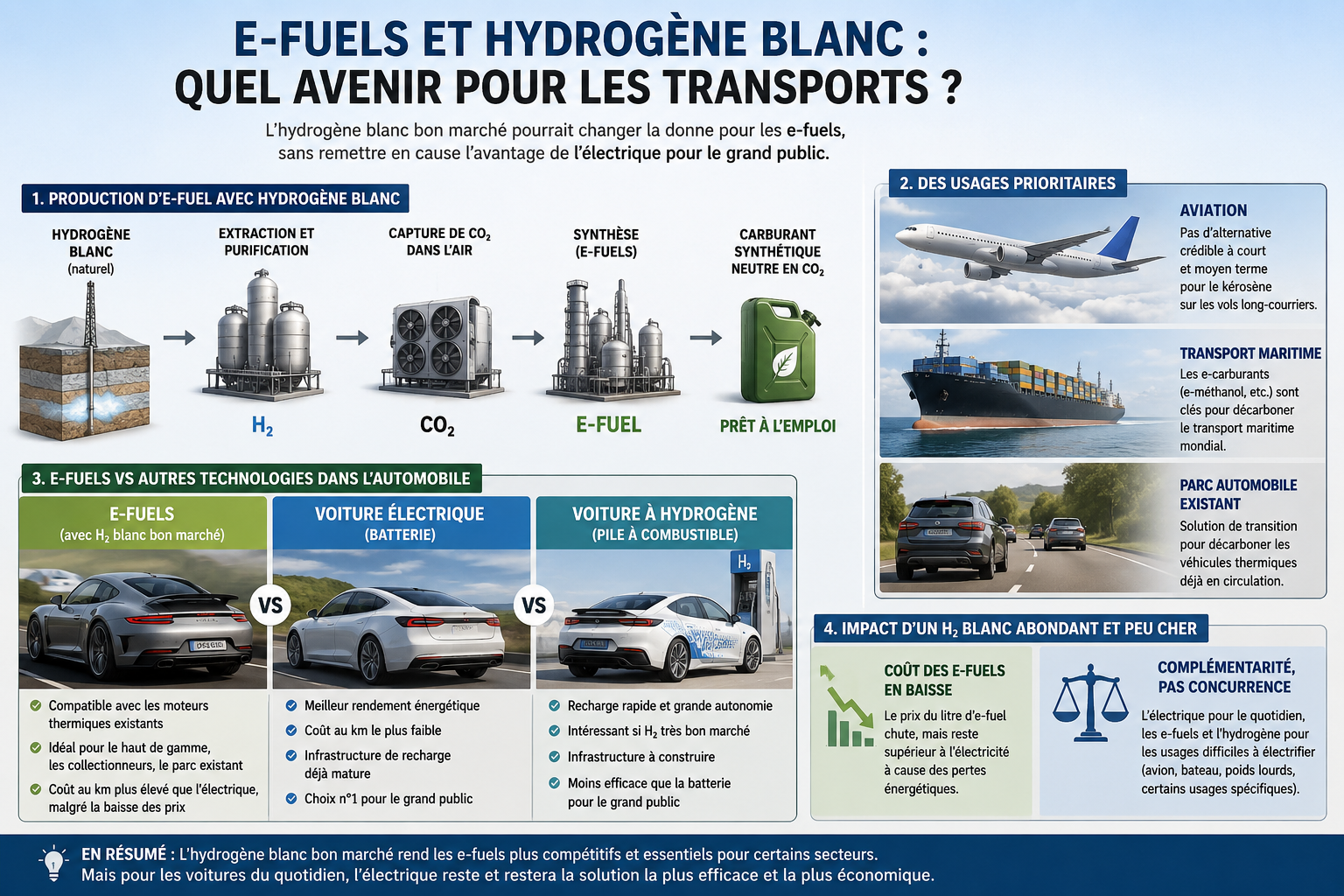
The fundamental critique of e-fuels for passenger cars has always been efficiency: a battery EV uses renewable electricity 3–5 times more efficiently per kilometre than a conventional combustion engine running on e-fuels. This argument is entirely valid for a direct comparison between a standard ICE and a battery EV.
The C15 range-extender changes the calculation. The engine runs only at its single optimal efficiency point — a fixed RPM where thermal efficiency is maximised, generating electricity to recharge the battery. It never experiences the inefficient partial-load conditions of a conventional engine in stop-start urban traffic. The energy losses from burning e-fuels are substantially reduced compared to conventional combustion, because the engine is essentially operating as a constant-load power station.
Combined with cheap e-fuels from natural hydrogen — at the projected €0.50/kg H₂ cost from Lorraine or Australian geological sources — the economics of this architecture change significantly. A small 15–20 kWh battery for daily urban use, recharged on a domestic socket overnight, plus e-fuel at near-parity pump prices for long-distance travel, eliminates the two main objections to battery EVs simultaneously: range anxiety and the cost of large battery packs.
The Electricity Grid Problem — Why This Architecture Does Not Stress the Network
The mass transition to pure battery EVs with large 60–100 kWh packs creates a specific infrastructure challenge: simultaneous fast charging at 150–350 kW per vehicle creates enormous grid peak demand. A weekend holiday departure evening, with millions of EVs simultaneously fast-charging, requires grid reinforcement at a scale that takes decades and hundreds of billions in investment to deploy.
The small-battery EREV architecture bypasses this problem entirely. A 15–20 kWh battery recharges on a standard domestic socket at 2.3–3.7 kW overnight — equivalent to running a large appliance. No fast charger needed. No grid reinforcement needed. For long journeys, the driver stops for 3 minutes at an existing petrol station and fills with e-fuel — energy that was produced, stored and distributed through the existing liquid fuel infrastructure, which acts as a buffer that completely absorbs the peak demand.
Instead of rebuilding an oversized global electrical grid at colossal cost, the chemistry of e-fuels transports and stores the energy, and the sobriety of a small battery handles daily urban use. It is a more fluid and realistic transition for the global majority.
syntheticfuels.ai · Editorial · June 2026Who Is This For? — Three Specific Markets
The Honest Assessment — What This Does and Does Not Solve
The Aramco-Horse thesis is coherent and the engineering is real. The Horse H12 and C15 are confirmed commercial developments, not concepts. Repsol’s 100% renewable fuel ran at Dakar 2026. The architecture genuinely solves range anxiety, grid stress, battery cost and charging infrastructure gaps simultaneously.
What it does not solve — and the analysis is honest about this — is the fundamental thermodynamic efficiency gap versus direct electrification for urban users with home charging access. A driver who charges overnight on a domestic socket and drives 30 km per day will always have a lower cost-per-kilometre in a pure EV. The Horse architecture is not the optimal solution for that user profile — and should not be presented as such.
- Current e-fuel cost — H₂ at €6.20/kg makes e-petrol ~€3.40/L · twice fossil pump price · mass market impossible without subsidy
- If REGALOR II confirms 2027 — H₂ at €0.50/kg makes e-petrol ~€1.80/L · approaching pump parity · Horse architecture becomes commercially compelling at scale
- Aramco’s strategic interest — cheap natural H₂ makes e-fuels competitive · Aramco’s existing distribution infrastructure carries the new fuel · value of their global assets is preserved
- The Greater Region opportunity — Lorraine natural H₂ + ArcelorMittal CO₂ (Liège/Luxembourg) + HY4Link pipeline + Horse production scale → first genuinely low-cost e-fuel production hub in Europe
- → Horse Powertrain — horsepowertrain.com — H12 Concept · C15 architecture · 5M engines/year
- → Cision News — “Horse Powertrain and Repsol jointly develop highly efficient engine using 100% renewable fuel” — February 2026
- → Gocar.be — “Renault et Geely vont-ils imposer ce moteur” · Horse C15 architecture — October 2025
- → Driven Car Guide — “New hybrid powertrain cuts fuel use by 40% on 100% renewable petrol” — February 2026
- → Reuters — Aramco 10% stake in Horse Powertrain confirmed
- → media.renaultgroup.com — Horse Powertrain shareholder structure · Renault 45% · Geely 45% · Aramco 10%
- → Repsol — “Ultra-efficient hybrid engine developed with Horse Technologies” — February 2026
- → FDE / REGALOR II — Lorraine natural hydrogen · Pontpierre 3,655m — October 2025





Leave a Reply